From Wikipedia
Open on Wikipedia | You can help expand this article with text translated from the corresponding article in German. (November 2025) Click [show] for important translation instructions.
|
| Malva neglecta | |
|---|---|

| |
Scientific classification 
| |
| Kingdom: | Plantae |
| Clade: | Tracheophytes |
| Clade: | Angiosperms |
| Clade: | Eudicots |
| Clade: | Rosids |
| Order: | Malvales |
| Family: | Malvaceae |
| Genus: | Malva |
| Species: | M. neglecta
|
| Binomial name | |
| Malva neglecta | |
| Synonyms[1] | |
|
List
| |
Malva neglecta is a species of plant of the family Malvaceae, native to most of the Old World except sub-Saharan Africa. It is an annual growing to 0.6 m (2 ft). It is known as common mallow in the United States and also as buttonweed, cheeseplant, cheeseweed, dwarf mallow, and roundleaf mallow.[2] This plant is often consumed as a food, with its leaves, stalks and seed all being considered edible.[3][4][5] This is especially true of the seeds, which contain 21% protein and 15.2% fat.[6]
Description
[edit]Dwarf mallow is a prostrate, downy, herbaceous plant, growing to approximately 60 cm (24 in). The leaves are alternate with long, strongly channeled petioles, up to 12 cm (4.7 in), and narrowly triangular stipules. It is a broadleaf winter annual that also persists through a biennial or perennial life cycle if environmental conditions are favorable.[7][8] Each leaf is reniform or with 5–7 shallow lobes, the basal leaves are 3–7 cm (1.2–2.8 in). It grows a tough taproot.[9] The flowers are single-stalked and occur in clusters of 2–5 in the leaf axils. The flower stalks are shorter than the leaf stalks, with the leaves partially obscuring the flowers. The fruits are schizocarps, which split into 10–12 mericarps (nutlets) and are smooth and hairy.[10][11]
In addition to daily phototropic movements, leaves show epinasty, geotropism and sleeping behaviors. Leaves joined to the stem on the east side of the plant bend abaxially and leaves on the west side of the plant bend adaxially, while leaves on the north and south sides turn sideways. Overnight, leaves were observed returning to their morning position.[12]

After introduction into Canada, common mallow was found to be freezing tolerant, retaining the capacity for photosynthesis and respiration after long periods of exposure to subfreezing temperatures.[13]
Life cycle
[edit]Malva neglecta exibits six age states: seedlings, juveniles, immatures, virginals, young generatives, and middle-aged generatives. Seedling leaf blades are pubescent below and along the edge. Juvenile plants have a solitary shoot and rounded leaves with wavy toothed edges. Immature plants show kidney-shaped leaves with jagged edges. Virginile plants present rosettes of 3-5 rounded heart-shaped leaves. Young generative plants develop solitary white or light pink flowers. Branching of the generative shoot is observed in Middle-aged plants.[14] While young leaves and stems are green, mature leaves and lower stems vary from green to purple in color.[15]
Ecology
[edit]Acyrthosiphon Malvae
[edit]Although the ecology is more complex, in the Thames valley, Acyrthosiphon Malvae (informally Aphis Malvae) is the common aphid found feeding on common mallow.[16]
Distribution
[edit]- Native
- Palearctic:
- Macaronesia: Canary Islands
- Northern Africa: Algeria, Morocco
- Arabian Peninsula: Saudi Arabia
- Western Asia: Afghanistan, Cyprus, Sinai, Iran, Iraq, Jordan, Lebanon, Historic Palestine, Syria, Turkey
- Caucasus: Armenia, Azerbaijan, Georgia
- Soviet Middle Asia: Kazakhstan, Kyrgyzstan, Tajikistan, Turkmenistan, Uzbekistan
- Mongolia: Mongolia
- China: Xinjiang
- Indian Subcontinent: India, Pakistan
- Northern Europe: Denmark, Ireland, Norway, Sweden, United Kingdom
- Middle Europe: Austria, Belgium, Czech Republic, Germany, Hungary, Netherlands, Poland, Slovakia, Switzerland
- Southeastern Europe: Albania, Bosnia and Herzegovina, Bulgaria, Croatia, Greece, Italy, Montenegro, North Macedonia, Sardinia, Serbia, Slovenia, Romania,
- Southwestern Europe: France, Portugal, Spain
Source:[17]
Uses
[edit]The plant has 1-Octacosanol,[18] Ascorbic (acid), Choline,[18] alkaloids, and saponin (the plant has a certain antioxidant content).[19] It has a high nitrate content, similar to that of arugula.[20][21] The flowers contain tannins.
Therapeutic
[edit]A common traditionally used medicinal plant, used for catarrh, enteritis, sore throat, hoarse voice, and as an expectorant.[22] A lab study has shown that the plant is good for stomach ulcers[23]
Seeds
[edit]The seeds can be eaten raw or cooked and have a nutty flavor.[20] Mature seeds can be cooked like rice or grains.[24] In the past, seeds were ground into flour in times of need.[25]
Root
[edit]The root can be ground and used as a meringue substitute[26] by boiling in water, simmering until thickened, and then whisked like egg whites.[27]
Leaves
[edit]Leaves are useful in salads, can be eaten raw, and contain Vitamin C, significant protein and mineral content.[28] In culinary applications, it is cooked similar to spinach, or used for thickening soups, as the leaves release a thickening agent similar to okra which is also in the mallow family. In Morocco leaves are known as Bakola or Khobiza, braised as a side dish (called salad, but cooked) or used as a sauce over couscous.[29] In Jewish and Egyptian cooking, leaves are made into a stew called Mulukhiyah.
Botanical gallery
[edit]-
 Plant spreads along ground, leaves not large, leaves fairly uniform size (Antalya)
 -
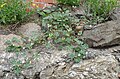 Spreading on rocks, similarly (Edinburgh)
 -
 Flowers, fruits and leaves
 -
 Flowers, fruits and leaves, closer
 -
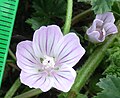 Flowers can be pink with bold veins or may be pale
 -
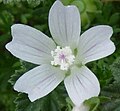 Paler form, hairs (visible) in centre at petal stalks
 -
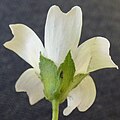 Flower much larger than calyx, green calyx with 5 broad parts, epicalyx at base formed of 3 narrow strips
 -
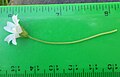 Flowers may have long to very long stalks
 -
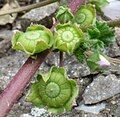 Fruits
 -
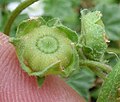 Fruits
 -
 Fruiting undersides, showing epicalyx of 3 narrow strips
 -
 Flowers and fruits from side showing the features above, stalks reasonably long
 -
 Hairs a mixture of stellate (star-like) and simple
 -
 Hairs a mixture of stellate (star-like) and simple
 -
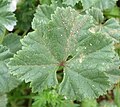 Leaf
Leaf -
 Leaf underside
 -
 Leaf underside


References
[edit]- ^ "Malva neglecta Wallr". Plants of the World Online. Royal Botanic Gardens, Kew. Retrieved 5 March 2025.
- ^ "Malva neglecta". Integrated Taxonomic Information System. Retrieved 9 May 2008.
- ^ Facciola S. Cornucopia – A Source Book of Edible Plants. Vista, Ca. Kampong Publications, 1990. 677 p.
- ^ Archived at Ghostarchive and the Wayback Machine: Wild Living with Sunny: Episode 16 - Mallow Plant S'mores. YouTube.
- ^ "Malva neglecta Dwarf Mallow, Common mallow PFAF Plant Database".
- ^ Duke JA. CRC Handbook of Proximate Analysis Tables of Higher Plants. Boca Raton, Fl. CRC Press, 1986. 389 p.
- ^ Patton, Aaron; Beck, Laura; Daniel, Kathy (3 December 2019). Spotlight on Weeds: Common Mallow (Malva neglecta) (PDF) (Report). Purdue Landscape Report. Purdue University. Retrieved 25 January 2026.
- ^ Donaldson, Susan; Mazet, Wendy Hanson (2010). A Northern Nevada Homeowner's Guide to Identifying and Managing Common Mallow: Malva neglecta (PDF) (Report). Fact Sheet 10-21. University of Nevada Cooperative Extension. Retrieved 25 January 2026.
- ^ Batsatsashvili, K.; Mehdiyeva, N.; Fayvush, G.; Kikvidze, Z.; Khutsishvili, M.; Maisaia, I.; Sikharulidze, S.; Tchelidze, D.; Alizade, V.; Aleksanyan, A.; Paniagua-Zambrana, N. Y. (2017). "Malva neglecta Wallr.; Malva sylvestris L.". In Bussmann, R. W. (ed.). Ethnobotany of the Caucasus (PDF). Cham: Springer International Publishing. doi:10.1007/978-3-319-49412-8_115. Retrieved 24 January 2026.
- ^ Stace, C.A. (2019). New Flora of the British Isles. Suffolk. ISBN 978-1-5272-2630-2.
{{cite book}}: CS1 maint: location missing publisher (link) - ^ Rose, Francis (2006). The Wild Flower Key. London: Frederick Warne. ISBN 978-0-7232-5175-0.
- ^ Yin, H. C. (1938). "Diaphototropic movement of the leaves of Malva neglecta". American Journal of Botany. 25 (1): 1–6. doi:10.1002/j.1537-2197.1938.tb09178.x.
- ^ Makowski, R. M.; Morrison, I. N. (July 1989). "The biology of Canadian weeds. 91. Malva pusilla Sm. (= M. rotundifolia L.)". Canadian Journal of Plant Science. 69 (3): 861–879. doi:10.4141/cjps89-101. Retrieved 24 January 2026.
- ^ Saribaeva, Shakhnoza (13 June 2024). Morphological variability and vitality of the cenopopulation of Malva neglecta Wallr. E3S Web of Conferences, SDEA-2024. doi:10.1051/e3sconf/202453705024.
- ^ Ketevan Batsatsashvili; Naiba P. Mehdiyeva; George Fayvush; Zaal Kikvidze; Manana Khutsishvili; Inesa Maisaia (2017). "Malva neglecta Wallr. Malva sylvestris L. Malvaceae". In Bussmann, R (ed.). Ethnobotany of the Caucasus (PDF). Springer. pp. 395–403. doi:10.1007/978-3-319-49412-8_115. Retrieved 29 January 2026.
- ^ Eastop, Victor F. (1971). "Keys for identification of Acyrthosiphon" (PDF). Bulletin of the British Museum (Natural History). Entomology. 26 (1): 52. ISSN 0524-6431. Retrieved 1 February 2026.
- ^ "Malva neglecta". Germplasm Resources Information Network. Agricultural Research Service, United States Department of Agriculture. Retrieved 20 April 2017.
- ^ a b "Plant Malva neglecta (Malvaceae) | Dr. Duke's Phytochemical and Ethnobotanical Databases". phytochem.nal.usda.gov. Retrieved 23 December 2025.
- ^ "PHYTOCHEMICAL SCREENING OF SOME SPECIES OF IRANIAN PLANTS (KURDISTAN PROVINCE )". www.ijpr-online.com. Archived from the original on 10 August 2004. Retrieved 23 December 2025.
- ^ a b "BPB : Vol. 27 (2004) , No. 5 702". www.jstage.jst.go.jp. Archived from the original on 3 March 2008. Retrieved 23 December 2025.
- ^ Anthony P. Knight, Richard G. Walter: Guide to Plant Poisoning of Animals in North America. Teton NewMedia, 2001, ISBN 978-1-893441-11-8. S. 28.
- ^ "Ethnobotanical Plant Malva neglecta | Dr. Duke's Phytochemical and Ethnobotanical Databases". phytochem.nal.usda.gov. Retrieved 23 December 2025.
- ^ Gürbüz, Ilhan; Ozkan, Ayse Mine; Yesilada, Erdem; Kutsal, Osman (3 October 2005). "Anti-ulcerogenic activity of some plants used in folk medicine of Pinarbasi (Kayseri, Turkey)". Journal of Ethnopharmacology. 101 (1–3): 313–318. doi:10.1016/j.jep.2005.05.015. ISSN 0378-8741. PMID 16085377.
- ^ Nyerges, Christopher (2017). Foraging Washington: Finding, Identifying, and Preparing Edible Wild Foods. Guilford, CT: Falcon Guides. ISBN 978-1-4930-2534-3. OCLC 965922681.
- ^ "LNVL - Regulus - Wilde Mehllieferanten". www.luxnatur.lu. Retrieved 23 December 2025.
- ^ Facciola, Stephen (1990). Cornucopia: A Source Book of Edible Plants. Vista, California: Kampong Publications. ISBN 978-0961018412.
- ^ "Malva neglecta". Plants For A Future. Retrieved 27 January 2026.
- ^ Özer, M.; Aksoy, M. (30 June 2019). "Mineral composition and nutritional properties of Malva neglecta and Malvella sherardiana consumed as vegetable in Central Black Sea Region of Turkey". Turkish Journal of Food and Agriculture Sciences. 1 (1): 18–23. ISSN 2687-3818.
- ^ Powell, Bronwen; Ouarghidi, Abderrahim; Johns, Timothy; Ibn Tattou, Mohamed; Eyzaguirre, Pablo (2014). "Wild leafy vegetable use and knowledge across multiple sites in Morocco: a case study for transmission of local knowledge". Journal of Ethnobiology and Ethnomedicine. 10 34. doi:10.1186/1746-4269-10-34. PMC 4008438. PMID 24708730.
External links
[edit] Media related to Malva neglecta at Wikimedia Commons
 Data related to Malva neglecta at Wikispecies
- UniProt. "Species Malva neglecta (Common mallow)". Retrieved 9 May 2008.
- Natural Resources Conservation Service (NRCS). "PLANTS Profile, Malva neglecta". The PLANTS Database. United States Department of Agriculture. Retrieved 9 May 2008.
- "Malva neglecta". Plants for a Future.
- "Malva neglecta". Calflora. Berkeley, California: The Calflora Database.
- Malva neglecta in the CalPhotos photo database, University of California, Berkeley

